
Codec - The Coordination Layer for Physical AI
From Hyperscaler Spending to Humanoid Robotics and RPA
CodecFlow (or CODEC) is the execution layer that allows AI agents to control robots and software through a shared intelligence stack. It standardizes data, provides a marketplace of operators, and rewards contributors with the CODEC token.
Since our first piece on Codec, the AI landscape has shifted dramatically. Capex on AI infrastructure has exploded across hyperscalers, GPU makers and raw materials suppliers, while robotics and humanoids are becoming more advanced by the day. This boom has also exposed how much robust coordination layers are needed to connect digital AI models to physical machines and enterprise workflows.
In this edition, we’ll look into how AI capex and hardware supply chains have accelerated since late‑2024, why robotics/humanoid adoption and RPA needs are converging on coordination layers like CodecFlow, and what to watch for in Codec’s ecosystem.
What Codec Is and Why It Matters
If you haven’t read our earlier piece, you can find it here. In case you didn’t, the TLDR is that Codec is a shared layer that bridges digital AI with physical hardware intelligence. It works by:
Unified data: A common data schema from sensor inputs that give robots and software agents a shared understanding of their environment.
Composable operators: Developers publish modular skills (vision, language, navigation) to a marketplace. These operators can be combined and monetized, allowing users to build agent workflows without rebuilding from scratch.
Fabric and marketplace: A distributed compute router ensures that these operators run on any hardware or cloud, while the marketplace handles discovery and royalties.
Compounding flywheel: When an operator improves, the performance gains propagate across all connected robots… adoption drives more contributions, creating a compounding feedback loop.
This design differentiates Codec from typical AI tooling. Instead of a single service or model, it aims to be the coordination layer for all robots and agents. That role becomes more important as the physical side of AI takes shape.
The New AI Capex Cycle and Robotics Surge?
Since late 2024, spending on AI infrastructure has ballooned. Google announced plans to more than double capex to $180 billion in 2026, primarily on servers and data centres to meet growing AI compute demand. Goldman Sachs estimates that hyperscaler cumulative AI capex could reach $527 billion in 2026, up from $465 billion previously.
Even after rapid growth, capex jumped 75 % yoy in Q3 though AI spending still accounts for only 0.8 % of global GD, matching the late 1990s telecom boom would require an adjusted equivalent of ~$700 billion in 2026.
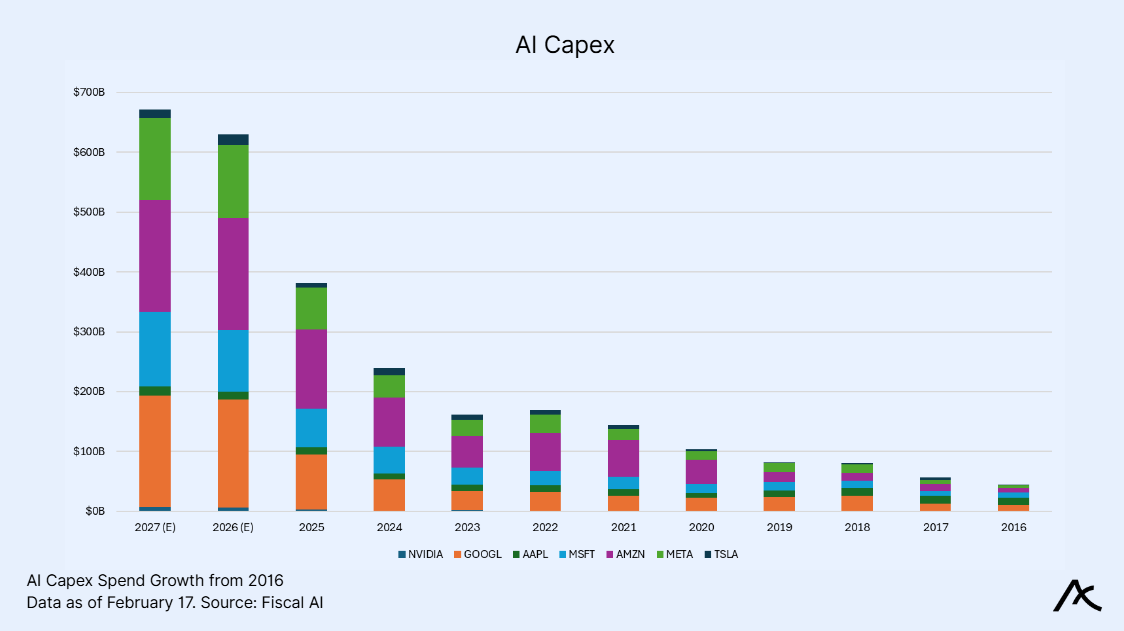
This means the capex cycle has plenty of headroom and the winners are not just cloud giants. GPU manufacturers, fabs and raw material suppliers (copper, rare earths, HBM) are now considered part of the AI supply chain. 2026 is forecasted to be a pivotal year for robotics as many move from demos into commercial deployment.
Venture investment in robotics startups grew from under $10B in 2024 to over $50B in 2025. Notable raises include ScaleAI’s $14.3B raise, Figure’s $1B raise, Apptronik’s $935M raise, Galbot’s $300M, Unitree’s $100M+ raise and impending IPO…you get the point.

Though the progress the past year in humanoid robots have been impressive, many demos still face issues like clumsiness, high power consumption and safety. This underscores the need for a robust intelligence layer that can manage tasks, integrate with control systems and adapt across platforms.
Core Update: What’s Changed for CodecFlow?
Since our last piece, Codec has shipped SimArena, turning simulation onboarding + environment creation into a wedge for developer distribution.
SimArena is designed to make robotics simulation faster to start, easier to modify, and openly extensible, with a workflow that includes (i) running full robotics simulations in the browser, (ii) generating 3D physics worlds from text prompts (powered by World Labs), (iii) dropping in custom robots/sensors to mirror real conditions, and (iv) contributing reusable simulation data. All this is open source.


Strategically, simulation is one of the biggest hidden bottlenecks in robotics (environment setup, asset pipelines, physics validation, iteration loops). If SimArena actually reduces the cost/time of “getting to first useful sim,” Codec can capture the earliest part of the robotics dev workflow before teams even choose model stacks, control frameworks, or deployment infrastructure.
Also, the surge in AI investment means more compute, more robots and more data. Companies building humanoids, RPA software and industrial IoT need a coordination layer that connects their hardware to modular skills and reasoning engines. CodecFlow’s unified data schema and operator marketplace are designed to serve that role.
Important Links

Become a Premium member today to unlock all our research & reports.
Join thousands of sharp crypto investors & traders by becoming a Premium Member & gain an edge in the markets. For just $149/month, you can access our full suite of offerings:
Gain access to Deep Dives, Blueprints, Perspectives, Theses, Benchmarks & Outlooks.
Weekly market update reports and key actionable insights, keeping you informed as the market evolves.
Full access to historical research archive, including hundreds of long-form reports.