
TRON - $90B in Stablecoin Liquidity, Now Open to Institutions
Regulatory Clarity, RWA Distribution & Agentic Payments as a New Institutional Push
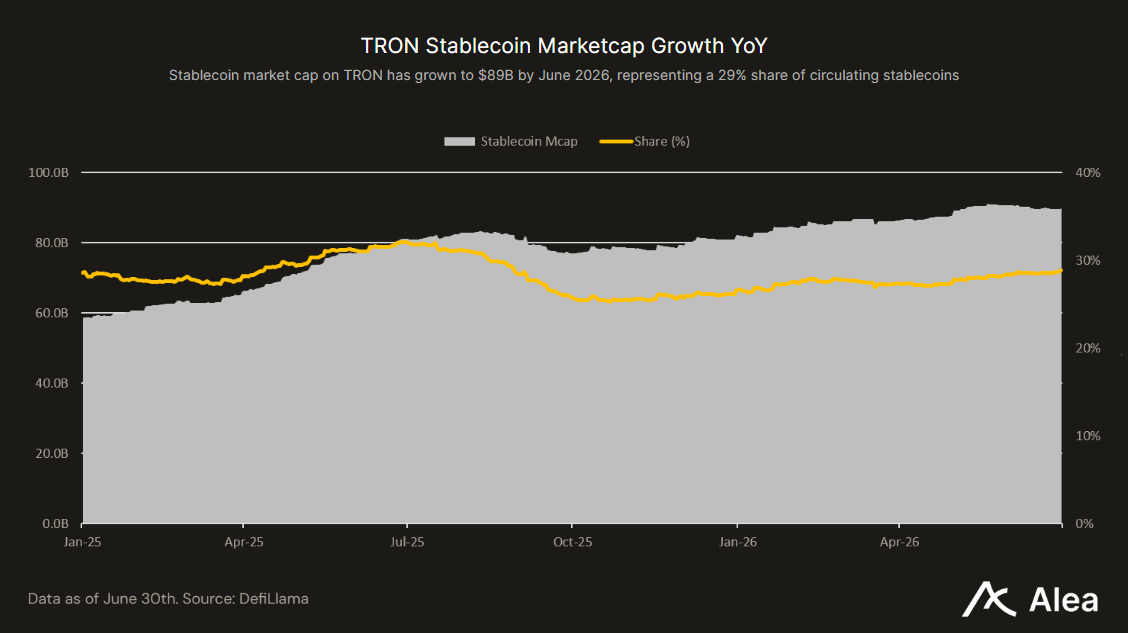
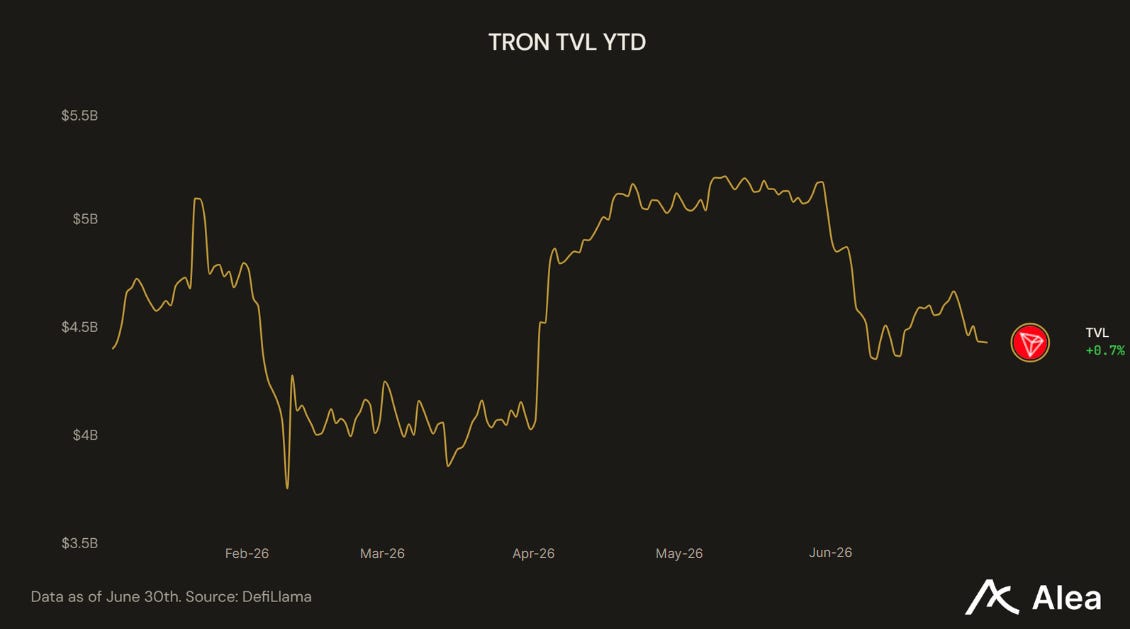
TRON settles more stablecoins than any other chain in crypto, over $2 trillion in USDT transfers in Q1 2026 alone. As of July 2026, the network has 392M+ user accounts, 14B+ transactions, $26B in TVL, and $90B in circulating USDT, processing approximately $22B in daily transaction volume. This makes it the largest stablecoin settlement layer in crypto by transaction volume.
Despite TRON’s scale in stablecoin settlement, crosschain access to its liquidity historically relied on exchanges, bridges, and custom integrations rather than widely adopted generalized interoperability infrastructure. Issuing regulated products on TRON once meant navigating an uncertain US regulatory backdrop, and developers on other chains could not tap its stablecoin liquidity without building a custom bridge. That backdrop has since turned friendlier, as the US regulatory and policy environment under the new administration moved toward supporting onchain development, and Securitize issued its first fund on the network on 2 June.
In this edition, we look at what changed the regulatory picture, how the first institutional fund reached TRON, and what still has to compound.
What TRON Is
TRON is a high-throughput L1 that launched in 2018 and became the dominant settlement layer for USDT. It holds over 47% of all USDT in circulation, more than sits on Ethereum. Its consensus design enhances speed and low fees while maintaining decentralization. The network processes daily stablecoin volume that rivals payment networks while keeping per-transaction costs near zero.
$26B in TVL is deployed across lending protocols, DeFi applications, and stablecoin liquidity on the network. The user base is predominantly retail and emerging market participants who use TRON for USD transfers where banking infrastructure is thin or expensive.
TRX, the native utility token of the TRON network, relisted on Binance.US, restoring US spot market access in TRX/USD and TRX/USDT pairs. The relisting reflects improved operating conditions following earlier regulatory developments, with a major US exchange restoring support for TRX trading. Anchorage Digital added TRX custody and TRON also joined Mastercard’s crypto partner program, linking its rail to card settlement.


Securitize Put the First Institutional Fund on the Network
On 2 June, Securitize issued its first asset on TRON, HLSCOPE, a tokenized feeder into Hamilton Lane’s Senior Credit Opportunities Fund, an evergreen private-credit strategy lending to senior secured borrowers across North America and Europe.


Tokenizing it drops the entry point from the $2M the underlying fund requires to a $10,000 minimum, with monthly subscription windows and a ~5.8% advertised yield. It reaches TRON’s 392M+ accounts as the fifth chain HLSCOPE runs on, after Ethereum, Polygon, Plume, and Optimism.
Securitize is a serious counterparty here, managing over $4B in tokenized assets for Apollo, BlackRock, KKR, VanEck, and BNY, and heading to public markets through a $1.25B SPAC merger under the ticker SECZ. HLSCOPE holds about $4.28M, a rounding error against $90B in stablecoins, so the launch proves the pipe works well before it proves demand.
TRON integrated with Hyperlane on April 9, a permissionless crosschain messaging protocol that connects TRON to 150+ blockchains. This lets developers deploy connections without centralized approval, choosing their own validator sets and security thresholds through Interchain Security Modules.

Agentic Payments
The third leg of the push aims at AI agents. TRON expanded its AI fund tenfold to $1B and joined the board of the Agentic AI Foundation alongside representatives from organizations including Circle and JPMorgan.

B.AI, announced April 15, is an attempt to make TRON the payment and identity layer for AI agents. The platform uses an onchain identity framework where each agent has a unique ID storing credentials and reputation, and implements the x402 payment standard for automated machine-to-machine value transfer.

The Catalyst
For years TRON was where dollars moved at scale, while institutional money stayed limited, held back by a legal cloud and a walled-off ledger. Both constraints are now gone, and Hamilton Lane’s fund is the first regulated product to launch on TRON. The growth signals from here are whether it scales past a few million dollars, and whether Securitize’s other funds from BlackRock, Apollo, and VanEck convert onto TRON.
A settlement layer with 392M accounts and $90B in stablecoins provides a potentially significant distribution channel. The initial launch demonstrates that institutional issuance on TRON is operational, with broader adoption depending on additional issuer participation. If the cadence picks up, TRON moves from remittance chain to a place where tokenized private markets reach a global retail base.
Important Links

Become a Premium member and get the full Alea platform.
Join thousands of sharp crypto investors & traders using Alea to evaluate opportunities and deploy with conviction. For just $149/month, Premium unlocks:
Full report suite: Deep Dives, Perspectives, Blueprints, Theses, Benchmarks, Memos & Pulse.
Protocol Data Rooms: Standardized due diligence portals with live analytics, risk matrices, and governance tracking across 24+ protocols.
Podcast Digest & Summit Digest: Key takeaways from the conversations shaping markets, so you don’t have to listen to every pod.
Governance Tracker: Live proposal feeds and voting activity across major protocols.
Full access to the historical research archive.