
Aleo - Privacy Stablecoins Go Legit
Circle's xReserv, zk L1, AleoBFT Consensus, Privacy Use‑cases, and More
The core function of stablecoins is to remove volatility from blockchain transactions, making onchain payments practical for traditional businesses. Yet most large enterprises still hesitate to adopt them.
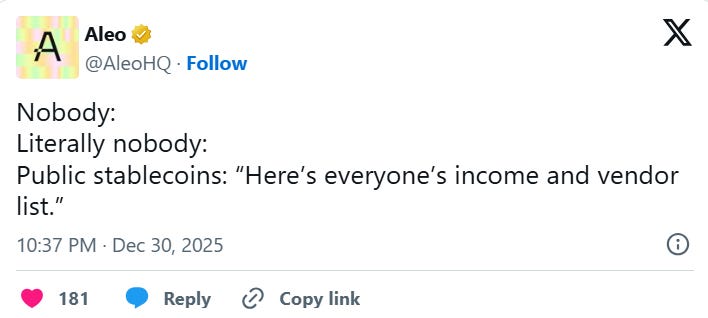
The obstacle isn’t regulatory uncertainty or technical complexity, but rather, privacy. On public chains, every stablecoin transaction is recorded in full view, broadcasting a company’s entire financial history. While transparency is hailed as a blockchain advantage, it becomes a liability when dealing with sensitive payment data.
Recently, Aleo and Circle launched USDCx on mainnet, a USDC-backed private stablecoin designed to solve this problem. The partnership represents the first major stablecoin issuer backing a privacy-preserving dollar asset.
In this edition, we’ll look into how Aleo works, their USDCx launch with Circle, and the broader context of programmable privacy and compliance.
Introduction to Aleo
Aleo is a L1 chain designed around zero-knowledge proofs. Unlike typical blockchains where validators execute transactions directly, Aleo allows users run programs offchain and generate ZK proofs attesting to correct computation. Only the proof is submitted to the network where validators verify and apply the state transition without seeing user inputs. Sensitive data never leaves the user’s device.

Consensus runs on AleoBFT, a proof-of-stake protocol derived from Narwhal-Bullshark. Three network roles share in block rewards: stakers delegate tokens to validators, validators run nodes and verify proofs, and provers generate proofs and solve the coinbase puzzle. The native token grants blockspace access, compensates participants, and enables staking and governance. Inflation starts at ~12% year one, tapering to 2% by year 10.
Aleo’s offchain computation with onchain proof verification is what enables private stablecoins. The network can verify that a payment is valid and compliant without ever seeing the sender, recipient, or amount.
The Problem with Public Stablecoins
The rise of privacy‑preserving stablecoins reflects two converging trends. First, businesses are moving more financial operations onchain. Payroll processors like Request Finance and Toku, B2B settlement networks, and fintech services need digital dollars that meet confidentiality expectations.
Regulators are also shaping standards for stablecoin backing and transparency (e.g the GENIUS Act), but have not yet addressed how privacy layers should be treated. USDCx navigates this by coupling full reserve backing and attestation with a privacy layer and compliance record. Aleo co‑founder Howard Wu described the design as “banking‑level privacy” where transactions are opaque to the public yet auditable by authorized parties.
This model differs materially from privacy coins. Monero and Zcash hide all transaction details and are therefore restricted on many exchanges, limiting their use in regulated contexts. USDCx, by contrast, is a stablecoin with a transparent reserve and selective disclosure, allowing Circle to produce compliance data when required.
The goal is not to evade oversight but to protect business intelligence (e.g salary amounts or vendor terms) from competitors and attackers. Permissioned privacy could make onchain payments palatable to enterprises that currently avoid blockchain due to exposure risk.
USDCx: Circle's Private Stablecoin Play
USDCx is a dollar-denominated stablecoin fully backed 1:1 by USDC held in Circle’s xReserve, a non-custodial smart contract infrastructure providing deposit attestations and minting verification. The structure integrates with Circle’s CCTP and Gateway, allowing USDCx to move into standard USDC on supported chains without third-party bridges.
USDCx went live on 27 Jan 2026, with the initial rollout targeting institutional users. Launch partners include payroll provider Toku, invoice processor Request Finance, analytics firm Dynamic, node operator Blockdaemon, and compliance specialists Chainalysis. These partners span payroll, vendor settlement, infrastructure, and compliance, underscoring the breadth of applications.

Critically, USDCx isn’t fully opaque. Every transaction includes a compliance record accessible to Circle for regulatory or law enforcement requests. Users can prove KYC/AML adherence without exposing data to the public ledger, making it a privacy-preserving model rather than full privacy.

Important Links

Become a Premium member today to unlock all our research & reports.
Join thousands of sharp crypto investors & traders by becoming a Premium Member & gain an edge in the markets. For just $149/month, you can access our full suite of offerings:
Gain access to Deep Dives, Blueprints, Perspectives, Theses, Benchmarks & Outlooks.
Weekly market update reports and key actionable insights, keeping you informed as the market evolves.
Full access to historical research archive, including hundreds of long-form reports.